Ultrasonic Algae Control for Cooling Towers | ALGAEFREE
24–60 Month Rent-to-Own
Cut Chemical & Maintenance Costs!


INDEVIN COOLING TOWER


ALPHA ULTRASOUND SYSTEM IN PIRRAMIMMA WINERY COOLING TOWERS

ULTRASOUND AGAINST SALMONELLA AND LEGIONELLA
READ BOTH PUBLISHED STUDIES:

ULTRASOUND AGAINST SALMONELLA – STUDY PUBLISHED 22 MAY 2018
High Intensity Ultrasound for Salmonella Enteritidis Inactivation in Culture and Liquid Whole Eggs
LINK: https://ift.onlinelibrary.wiley.com/doi/abs/10.1111/1750-3841.14185

ULTRASOUND AGAINST LEGIONELLA – STUDY PUBLISHED 03 FEB 2010
https://www.sciencedirect.com/science/article/abs/pii/S004313540900654X
Legionella and Biofilm
Rivers, lakes, sediment, sludge, scale, soils organically rich environments growth between 68 – 113 F
– dormant @ lower temperatures and does not survive above 140 F.
Aerobic, parasitic, Proto zoonotic Legionella is a major cooling water treatment control issue.
Biofilm provides an environment for its rapid growth, then releases it into bulk water.
VEOLIA 100m x 100m IRRIGATION DAM
93% PROVEN RESULTS — SEE THE DIFFERENCE IN PICTURES
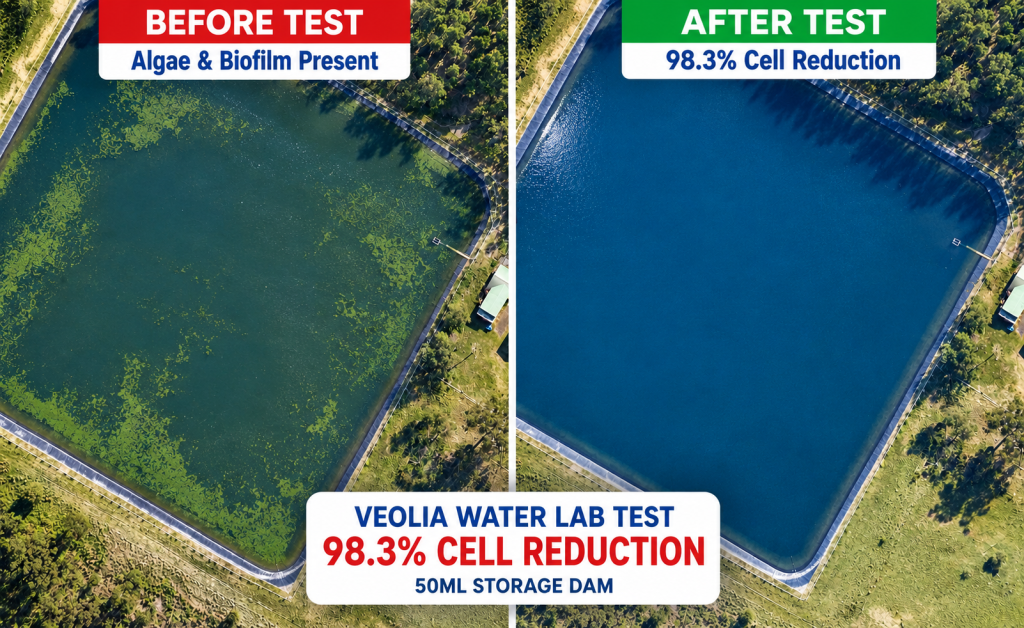
 READ VEOLIA’S OUTSTANDING TEST RESULT
Veolia Ref Algae Ultrasound Trial – 98% algae cell reduction

WHY KEEP PAYING FOR CHEMICALS?
Invest in ultrasound for long-term algae and biofilm control.
Ultrasound offers a chemical-free treatment approach with a one-time equipment investment, helping reduce ongoing chemical use and maintenance costs.
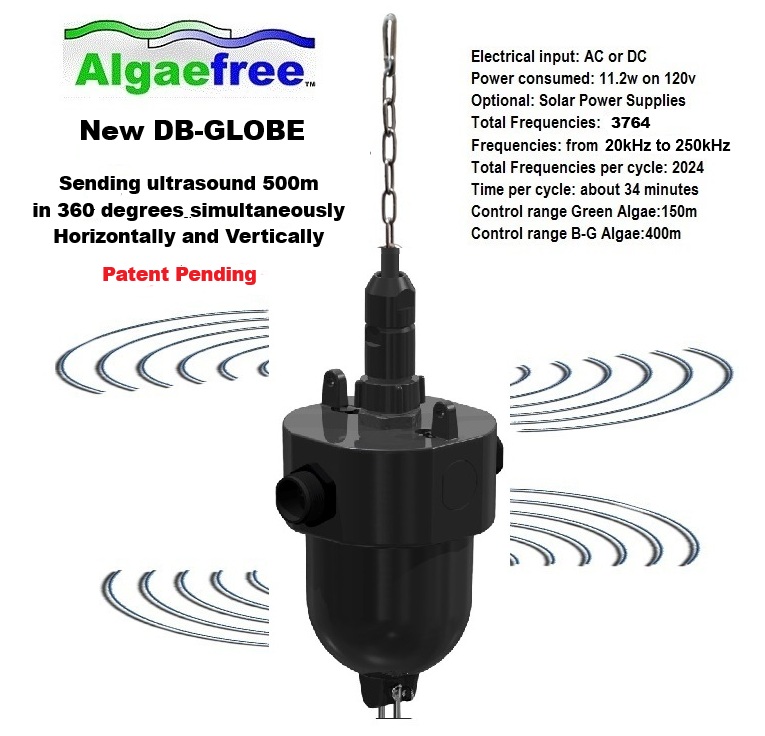
MEET THE ALPHA DB-GLOBE — STRONGER, SMARTER AND MORE VERSATILE
Introduced in 2025, the ALPHA DB-GLOBE combines increased ultrasound output with expanded frequency options and broader bandwidths.
Its advanced electrical conversion technology delivers greater ultrasound output. Selected models also offer adjustable bandwidths, frequency settings and enhanced communication capabilities, providing greater control over operation.
System monitoring and error reporting help users check performance and identify faults.
The system uses Critical Structure Resonance (CSR) technology, designed to target algae and other microorganisms through selected ultrasound frequencies. Finer frequency adjustments provide more options for targeting different organisms.
ALPHA ULTRASOUND FOR COOLING TOWERS
Cooling towers remove heat from circulating water by bringing it into contact with air. Water is pumped to the top of the tower and flows over internal fill material, which increases the surface area exposed to air. Evaporation cools the remaining water, which collects in a basin or sump before recirculating through the system.
Cooling towers range from compact rooftop units to large industrial installations. Their collection basins are commonly constructed from fibreglass, metal or concrete.
Reliable water-level control is essential. Automatic controls replenish water lost through evaporation and other processes, maintain the correct operating level and protect pumps from running dry.

ALGAE AND BIOFILM CONTROL IN COOLING TOWERS, TANKS AND PIPEWORK
The ALPHA ultrasound system is designed to help manage algae and biofilm in water systems, supporting cleaner equipment as part of a wider water-treatment programme.
WHY BIOFILM MATTERS
Biofilm develops on submerged surfaces, including tank walls and pipes, and can provide a habitat for microorganisms such as Legionella. Managing biofilm is an important part of controlling water-system hygiene.
UNDERSTANDING LEGIONELLA
Legionella bacteria can multiply under favourable water conditions. Inhaling contaminated water droplets from sources such as cooling towers can cause Legionnaires’ disease, a serious form of pneumonia.
ULTRASOUND AS PART OF WATER MANAGEMENT
Ultrasound should complement an established treatment programme. It should not replace validated disinfection, regular cleaning, monitoring or other Legionella control measures. Cooling-tower management must address biofilm, sediment, temperature, stagnation and disinfectant levels.
Any claim that ALPHA reduces Legionella or makes drinking water safe requires independent testing specific to the system and its operating conditions. Changes to chemical dosing should be assessed by a qualified water-treatment professional.

BACTERIA AND BIOFILM IN COOLING SYSTEMS
Bacteria can attach to submerged surfaces and form biofilm—a community of microorganisms held within a slimy matrix known as extracellular polymeric substances (EPS).
This layer can encourage further fouling. Depending on the water conditions, algae and other organisms—including mussels and barnacles in seawater systems—may settle and grow.
Biofouling can reduce heat transfer efficiency, increase energy demand, contribute to corrosion and raise cleaning and chemical-treatment costs.

REPORT FROM ELKEM SOLAR, NORWAY
In June 2017, ELKEM Solar installed the ALPHA 4-Ways ultrasound system at its seawater reservoir intake to address ongoing heat exchanger problems caused by fouling.
ELKEM Solar experienced extensive mussel buildup on intake grates and inside seawater pipes at its factory. This impaired heat exchanger performance and increased water temperatures, requiring frequent and costly cleaning of the pipes and grates.
Four months after installing ALPHA 4-Ways, visual inspections of the seawater intake basin and other components showed a reduction in mussel numbers.
Maintenance Planning Manager Gert Ivar Gundersen of ELKEM Solar AS reported that almost no mussels remained following installation. The few still present were dead. He also noted a reduction in biofilm and algae on the walls.
ELKEM Solar AS agreed to act as a reference for other businesses experiencing similar seawater fouling and mussel problems.
Contact person for the references: Maintenance Planning Infrastructure by Elkem Solar AS, Norway is Gert Ivar Gundersen
Mobile phone Norway: + 47 9824 0809
Email: gert.ivar.gundersen@elkem.no

ALPHA 4-ways hanging from chain at a water reservoir in ELKEM Norway

ALPHA ULTRASOUND FOR ALGAE AND BIOFILM CONTROL IN COOLING TOWERS
The ALPHA ultrasound system is designed to help control algae and biofilm in cooling-tower water, supporting cleaner equipment as part of a comprehensive water-treatment programme.
Algae and biofilm can accumulate on cooling-tower basins, fill material and other wetted surfaces, restricting water flow and reducing heat transfer efficiency.
Biofilm forms when microorganisms attach to surfaces and develop a protective, slimy matrix known as extracellular polymeric substances (EPS). This layer can trap organic matter and support further fouling.
Biofouling can increase energy demand, contribute to corrosion and raise cleaning, maintenance and chemical-treatment costs.
Where demonstrated by site-specific testing, ultrasound may help reduce chemical demand. Any reduction in dosing must maintain effective disinfection and Legionella control and be assessed by a qualified water-treatment professional.

ALPHA CONTROL SYSTEM
The ALPHA 4-Ways ultrasound system uses powerful transducers to transmit ultrasound simultaneously in four directions. It is designed to help control algae and biofilm in cooling-tower water, supporting cleaner equipment and more efficient operation.
Chillers and cooling towers represent a substantial capital investment and can account for a significant share of a facility’s energy and operating costs. Keeping heat exchangers, condensers and associated pipework clean is essential to maintaining performance.
By helping manage biological fouling, ALPHA can support heat transfer efficiency and reduce cleaning and maintenance demands. Results depend on water conditions, system design and installation.
Ultrasound should form part of a comprehensive water-treatment programme, alongside appropriate scale and corrosion control, disinfection and regular maintenance.
ALPHA DB-GLOBE 360 sending ultrasound waves in 4 directions simultaneously.


WHAT IS BIOFILM?
Biofilm is a community of microorganisms that attaches to a surface and develops a protective, slimy matrix. It commonly forms wherever moisture and nutrients are available, including water tanks, pipes, cooling towers and heat exchangers.
Biofilm can harbour harmful microorganisms, contribute to fouling and make cleaning and disinfection more difficult. Effective management involves limiting its formation and removing established deposits.
HOW ALPHA ULTRASOUND WORKS
The ALPHA ultrasound system transmits sound waves through water and is designed to help control algae and biofilm. Its frequency programmes target susceptible organisms, with performance depending on the species present, acoustic output, water conditions and installation.
Managing biological fouling can help keep equipment cleaner and support more efficient operation.
EVIDENCE AND PERFORMANCE
Ultrasound has been investigated for algae control and microbial reduction. However, results from laboratory equipment or other ultrasonic systems do not automatically establish the performance of a particular ALPHA installation.
Claims about percentage reductions, bacterial control or chemical savings should be supported by testing specific to the equipment and application.
CHEMICAL USE AND WATER SAFETY
Where verified by site testing, ultrasound may help reduce chemical demand associated with algae and biofilm management.
Cooling towers still require effective disinfection, cleaning, monitoring and Legionella control. Any change to chemical dosing should be assessed by a qualified water-treatment professional.
UNDERSTANDING LEGIONELLA
Legionella bacteria can grow in water systems under favourable conditions. Biofilm, sediment, stagnation, temperature and inadequate disinfectant levels can contribute to growth. Inhaling contaminated water droplets can cause Legionnaires’ disease.
ALPHA should complement an established water-management programme. A claim that it controls Legionella requires independent validation.
POTENTIAL APPLICATIONS
Heat exchangers and cooling systems
Help manage biological fouling that can restrict flow and impair heat transfer.
Water tanks and reservoirs
Support algae and biofilm management. Drinking-water applications require appropriate equipment suitability and validated treatment.
Freshwater and seawater systems
Help manage susceptible fouling organisms where installation and acoustic coverage are suitable.
Maintenance support
Complement filtration, cleaning and water treatment. Scale, corrosion, silt and sludge require their own control measures.